


Compare an EOR and Korean subsidiary for hiring in Korea, including control, cost, compliance, payroll and when to establish your own entity.
Category Archives: Payroll in Korea

30
Sep
Sep
How KTE supports a global EOR provider with practical Korea payroll cost simulations, clear assumptions and responsive local guidance before and after hiring.
Case Studies, Payroll in Korea
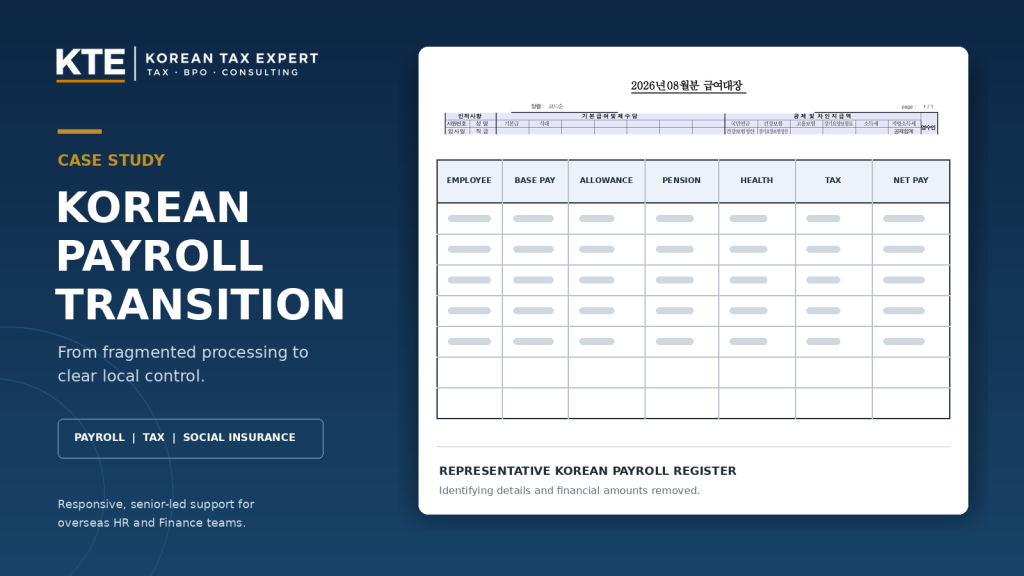
Case Study: From Payroll Provider Transition to Stable Complex Payroll Operations in Korea
25
Sep
Sep
How STAR TAX & BPO transitioned and stabilized complex Korean payroll for a foreign-invested company with approximately 100 employees, including foreign workers, fixed-term staff, complex bonuses and labor-inspection support.

23
Sep
Sep
Foreign employers planning their 2027 Korea payroll budget should account for the KRW 10,700 minimum wage, the 10% National Pension rate, severance and practical funding controls.

20
Aug
Aug
Calculate the cost of hiring an employee in Korea in 2026, including employer social insurance contributions and statutory severance.

19
Aug
Aug
Learn how Korea severance pay is calculated, who qualifies, the 14-day payment deadline, DB and DC retirement pensions, and mandatory IRP transfer rules.
Expat payroll in Korea must capture overseas pay, shadow payroll, tax equalization and equity. Learn the controls foreign employers need.

31
Jul
Jul
earn how unemployment benefits in Korea affect employer reporting, separation reasons, the 180-day rule and job-separation documentation.
Terminating an employee in Korea requires just cause, written notice and careful payroll handling. Learn the key rules for foreign employers.
Korea year-end tax settlement requires employers to finalize annual wage tax. Learn the process, foreign employee issues and payroll risks.
Hiring employees in Korea? Learn the payroll, year-end tax settlement, termination and social insurance risks foreign employers often miss.
Confirmed 2026 Korea social insurance contribution rates for employers and HR teams, covering National Pension, health insurance, long-term care, employment insurance and workers’ compensation.
The image is sourced from the National Health Insurance Service (NHIS) of Korea. For more detailed information, you can visit their official website. In Korea, both employees and employers contribute to several social insurance programs designed to provide financial security and support for workers. For 2024, these contributions are distributed across […]
Korea’s 4 Major Insurances stand out distinctly from those of other countries, presenting numerous distinctive features. In this article, we aim to delve into the specifics of the Korean National Health Insurance within the 4 Major Insurances, highlighting its unique aspects. I. Brief Introduction of Korean National Health Insurance for Employees Mandatory Enrollment and National […]
In the dynamic world of global business, cross-border mobility of employees has become a norm. Many companies send their employees abroad on assignments, and South Korea is no exception. For foreign employees stationed in Korea, one common practice is the adoption of NET payment contracts. Let’s delve into the concept of NET payment contracts and […]
- 1
- 2