

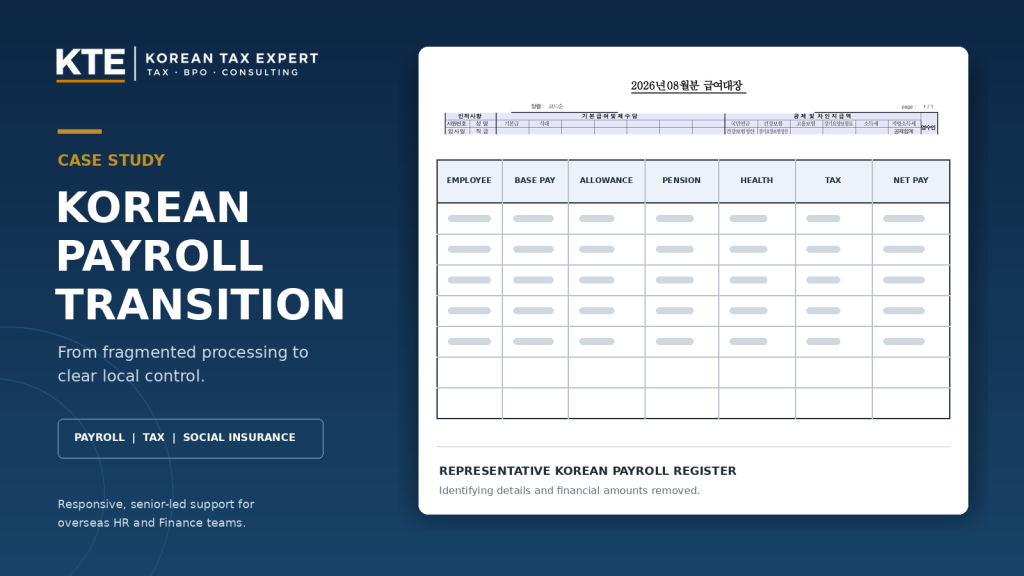
To protect client confidentiality, identifying details and non-essential facts have been generalised.
Changing payroll providers in Korea is not simply a matter of sending the latest payroll register to a new firm.
Payroll data are connected to withholding tax, local income tax, social insurance, year-end tax settlement, severance and retirement benefits, employee changes and, in some cases, expatriate compensation reported outside Korea. When the handover takes place during the year, incomplete historical data can affect every payroll cycle that follows.
In this case, a foreign-invested company decided to transfer its Korean payroll from a large global provider to STAR TAX & BPO. The company was not simply looking for a lower-cost calculation service. Its overseas headquarters wanted clearer local ownership, more responsive English communication and a payroll process that connected Korean compliance with practical monthly execution.
The Client’s Objective
The overseas HR and Finance teams needed a Korean payroll provider that could:
- communicate directly in English without repeated internal handoffs;
- explain Korean payroll, withholding tax and social insurance requirements in practical terms;
- take ownership of the local payroll timetable and follow-up items;
- coordinate employee changes, payroll inputs, filings and payment information; and
- identify issues early enough for headquarters to make an informed decision.
The concern was not limited to whether the final net-pay figures were mathematically correct. Headquarters also needed to know who was responsible for each step, what information was still outstanding and whether a payroll decision would have a Korean tax, social insurance or employment consequence.
Challenge 1: Reconstructing the Year-to-Date Payroll Position
A mid-year payroll transition requires more than employee names and current monthly salaries.
The opening data set may need to include:
- employee master data, employment dates and current contractual terms;
- recurring and variable compensation;
- taxable and non-taxable allowances;
- year-to-date gross pay and income tax already withheld;
- local income tax withholding;
- social insurance enrolment, reported remuneration bases and adjustments;
- foreign employee tax and social insurance positions;
- severance or retirement-plan information;
- prior corrections and unresolved items; and
- information needed for the year-end tax settlement.
A single payroll summary may not show whether these figures agree with withholding tax returns, social insurance notices or the records used by the former provider. The transition therefore had to be treated as a reconciliation project, not merely a file transfer.
Challenge 2: Clarifying Responsibility Between Headquarters and Korea
Under the previous arrangement, questions could pass through several teams before reaching someone familiar with the Korean issue. This is a common difficulty in globally coordinated payroll models: the contractual structure may be international, while the answer still depends on Korean tax, social insurance or payroll practice.
A bonus, new hire, unpaid leave period, employee departure or overseas payment can affect more than one part of the payroll process. If responsibility is fragmented, the calculation may proceed while a related filing, payment or employee communication remains unresolved.
The client wanted one local point of contact who could see the full workflow and explain what action was required from headquarters.
Challenge 3: Protecting the Monthly Payroll Timetable
Payroll cannot pause while the handover is being completed.
Employee inputs, approval dates, payslips, salary payments, withholding obligations and social insurance reporting continue according to their normal timetable. The transition plan therefore needed to separate items required for the first live payroll from historical matters that could be reconciled and documented through a controlled follow-up process.
How STAR TAX & BPO Responded
- Defined the cutover scope and responsibilities. We prepared a practical handover map covering the former provider, overseas headquarters, the Korean entity and our team. This clarified which party would provide, review, approve and execute each item.
- Issued a structured handover request. Instead of asking only for the latest payroll register, we organised the required employee, payroll, tax and social insurance records into a clear request list.
- Reconciled the year-to-date position. We reviewed the opening information across payroll registers, withholding data and available social insurance records, and identified items requiring clarification before they were carried into the new process.
- Established a bilingual monthly calendar. Headquarters received a clear timetable for payroll inputs, draft review, approval, payslips, filings and payment information.
- Provided senior-led local coordination. Questions were handled by professionals familiar with Korean payroll and tax rather than passed repeatedly between service teams.
- Connected payroll with the surrounding compliance work. Depending on the agreed scope, the process could extend beyond calculation to withholding tax, social insurance, payment administration, year-end settlement and headquarters reporting.
- Documented exceptions and follow-up items. Unusual employee arrangements and unresolved historical points were tracked separately so they would not disappear into the monthly routine.
The Result
The client moved to a defined Korean payroll process with one responsive local point of contact. Overseas HR and Finance teams gained clearer visibility over monthly deadlines, required approvals and outstanding issues.
The transition also created a stronger foundation for later payroll cycles. Historical information was not treated as a one-off import; it became part of the working records needed for withholding tax, social insurance, year-end settlement and employee exits.
Most importantly, headquarters could raise a Korean payroll question and receive a practical explanation of what needed to be decided, what supporting information was required and which downstream tasks could be affected.
What Foreign Employers Can Learn From This Case
- A payroll transition is a compliance handover. Current net pay alone is not enough. The new provider needs the history behind the figures.
- Do not rely on a single summary file. Payroll registers should be considered together with tax, social insurance and employee records.
- Define responsibility before the first live payroll. Clarify who provides inputs, approves calculations, makes payments, files returns and answers employee questions.
- A mid-year transition is possible. However, year-to-date information must be reconciled carefully so that problems are not carried into year-end settlement.
- Responsiveness is a control, not merely a convenience. A delayed answer can affect payroll approval, employee communication, filing or payment timing.
- Senior local involvement matters. Korean payroll decisions often sit across tax, social insurance, employment administration and finance operations.
How We Support Korean Payroll Transitions
STAR TAX & BPO supports foreign-invested companies that are establishing their first Korean payroll, replacing an existing provider or bringing a fragmented payroll process under clearer local control.
Our support can include payroll calculation, payslips, withholding tax, social insurance administration, year-end tax settlement, expatriate and foreign employee matters, severance and retirement processes, payment administration and English reporting to overseas headquarters.
Learn more about our Payroll & Global Mobility Services.
If your company is considering a Korean payroll provider transition, contact us at siyoon@star-tax.kr. A short review of the current payroll structure and available handover data can help define the scope before the transition begins.
The accompanying image is based on a Korean payroll register used in payroll and withholding-tax administration. All identifying details and financial amounts have been removed.
Important Notice
This case study is provided for general information and does not constitute tax, labour-law or legal advice. The correct payroll transition process depends on the employer’s workforce, payroll history, social insurance status, compensation arrangements and agreed service scope.
