
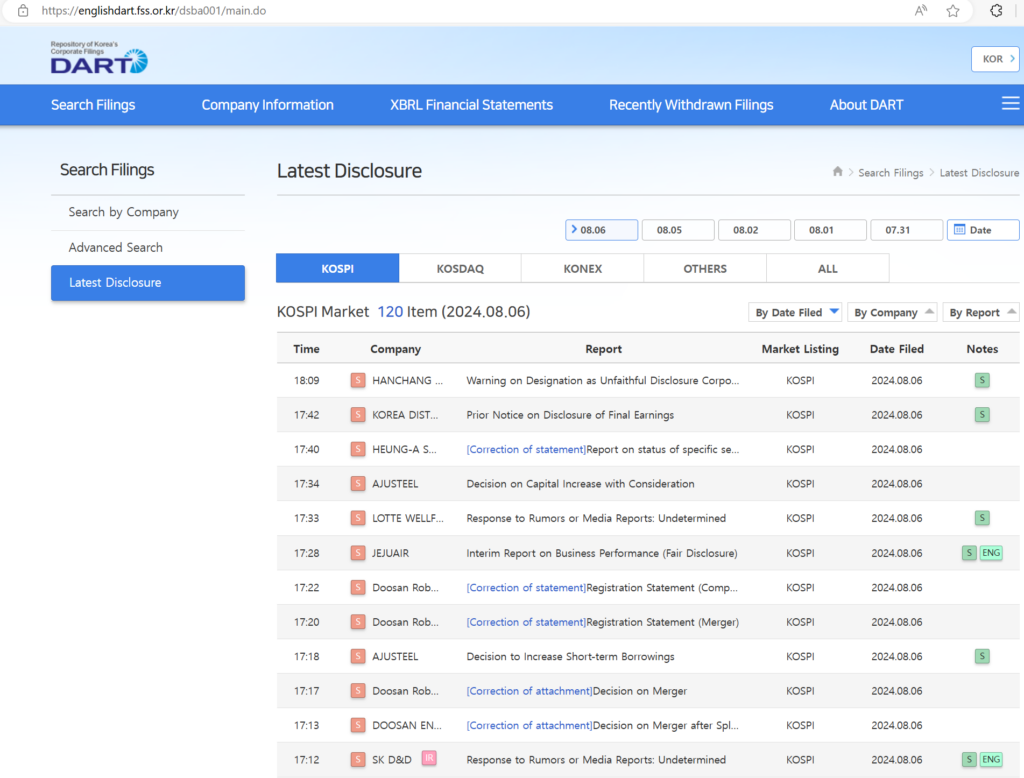
The image above shows the screen you will see when you access the Korean corporate disclosure website at https://englishdart.fss.or.kr/dsba001/main.do.
A privately held company in Korea may still be legally required to obtain an independent external audit. Listing status is not the only test. A Korean subsidiary can become subject to statutory audit because of its assets, liabilities, revenue or employee count, even when it has only one shareholder and is wholly owned by an overseas parent company.
This guide explains the principal external audit requirements in Korea under the Act on External Audit of Stock Companies and its Enforcement Decree, based on the rules in effect as of August 21, 2026.
The analysis should be performed for each fiscal year using the company’s status and the relevant figures for the preceding fiscal year. Foreign ownership does not create an exemption.
Which Companies Are Subject to External Audit in Korea?
The Act first requires an external audit for:
-
companies with listed shares;
-
companies seeking to become listed during the current or following fiscal year; and
-
other companies that meet the size criteria prescribed by the Enforcement Decree.
The size tests differ slightly between a stock company (Jusik Hoesa, 주식회사) and a limited company (Yuhan Hoesa, 유한회사).
External Audit Thresholds for a Korean Stock Company
An unlisted stock company is generally subject to statutory external audit if it meets any one of the following tests.
1. Asset test
-
Total assets at the end of the preceding fiscal year are KRW 50 billion or more.
2. Revenue test
-
Revenue for the preceding fiscal year is KRW 50 billion or more.
If the preceding fiscal year was shorter than 12 months, revenue is annualized. For this purpose, a period of less than one month is treated as one month.
3. Combined test
The company meets at least two of the following four conditions:
-
total assets of KRW 12 billion or more at the end of the preceding fiscal year;
-
total liabilities of KRW 7 billion or more at the end of the preceding fiscal year;
-
revenue of KRW 10 billion or more for the preceding fiscal year; or
-
100 or more employees at the end of the preceding fiscal year.
The employee test is not simply a headcount taken from the payroll register. The Enforcement Decree excludes qualifying daily workers under the Enforcement Decree of the Income Tax Act and dispatched workers under the Act on the Protection of Temporary Agency Workers. Companies close to the threshold should therefore review the legal classification of their workforce rather than relying only on an HR system total.
Special Thresholds for a Korean Limited Company
A limited company is generally subject to statutory external audit if it meets any one of the following tests.
1. Asset or revenue test
-
Total assets at the end of the preceding fiscal year are KRW 50 billion or more; or
-
revenue for the preceding fiscal year is KRW 50 billion or more.
2. Combined test for a limited company
The limited company meets at least three of the following five conditions:
-
total assets of KRW 12 billion or more;
-
total liabilities of KRW 7 billion or more;
-
revenue of KRW 10 billion or more;
-
100 or more employees; or
-
50 or more members (sawon, 사원) recorded in the articles of incorporation.
In this context, “members” means equity members of the limited company, not employees.
Important Five-Year Rule After Conversion to a Limited Company
A company should not assume that converting from a stock company to a limited company immediately gives it the more generous limited-company combined test.
If a company converted from a stock company to a limited company on or after November 1, 2019, the stock-company criteria continue to apply for five years from the date the conversion was registered. During this period, meeting two of the four stock-company conditions may still trigger the audit requirement.
This rule is particularly relevant when a foreign group reorganizes an existing Korean subsidiary.
Practical Examples
Example 1 — Stock company meeting two combined conditions
Assume an unlisted stock company has:
-
assets of KRW 15 billion;
-
liabilities of KRW 8 billion;
-
revenue of KRW 6 billion; and
-
40 employees.
The company meets the asset and liability conditions. Because a stock company only needs to meet two of the four combined conditions, it is generally subject to external audit.
Example 2 — Limited company with the same figures
Assume a limited company has the same figures and fewer than 50 members. It meets only two of the five limited-company conditions. It would not become subject to external audit under the combined test alone, unless another rule applies—for example, the five-year conversion rule described above.
Example 3 — Revenue alone exceeds KRW 50 billion
If either a stock company or a limited company records annual revenue of KRW 50 billion or more, the revenue test alone generally triggers the external audit requirement. It does not matter that the other thresholds are not met.
Are Newly Incorporated Companies Exempt?
A company first registered during the current fiscal year is among the companies that may be excluded from the external audit requirement for that fiscal year under the Enforcement Decree.
However, this should not be interpreted as a permanent exemption. The company should reassess its status after the first year, using the applicable preceding-year figures. Separate rules may also apply to listed companies, prospective listed companies and companies regulated under other legislation.
Certain other companies—such as qualifying companies in liquidation, bankruptcy, prolonged suspension of business or a merger process—may also be excluded in specified circumstances. These exclusions should be reviewed individually rather than assumed.
Why Foreign-Invested Companies Should Monitor the Thresholds Early
Foreign-invested companies often identify the external audit requirement too late because the Korean subsidiary is privately held or has only a small local management team. Neither fact prevents the company from meeting the statutory thresholds.
Late identification can create practical problems, including:
-
insufficient time to select and appoint an eligible external auditor;
-
delays in audit planning and year-end closing;
-
difficulty obtaining confirmations and supporting documents from overseas headquarters;
-
unexpected audit fees and additional accounting work; and
-
potential non-compliance with auditor appointment and reporting procedures.
The threshold review should therefore be incorporated into the year-end closing process. Companies approaching any of the limits should perform a preliminary assessment before the fiscal year closes and discuss the result with a Korean certified public accountant.
A Threshold Is Only the Starting Point
Determining whether a company is subject to statutory audit can require more than comparing four numbers. The company may need to consider:
-
its legal form;
-
whether it was converted from a stock company to a limited company;
-
the length of the preceding fiscal year;
-
the proper classification of employees and dispatched workers;
-
its listing plans;
-
whether a specific statutory exclusion applies; and
-
whether another law independently requires an audit.
If your Korean subsidiary is close to one or more thresholds, it is safer to confirm its status before beginning the year-end audit and corporate tax timetable.
Need Help Reviewing Your Korean Company’s Audit Status?
Korean Tax Expert supports foreign-invested companies with Korean accounting, statutory reporting and external audit coordination. If you would like us to assess whether your company meets the external audit requirements in Korea, please contact our team.
Official References
- Act on External Audit of Stock Companies — Korean Law Information Center
- Enforcement Decree of the Act on External Audit of Stock Companies — Korean Law Information Center
- DART Corporate Disclosure System — Financial Supervisory Service
This article is provided for general information only and does not constitute accounting, legal, or regulatory advice. The applicable requirements may vary depending on the company’s legal form, financial statements, workforce composition, conversion history, listing plans, and other relevant circumstances or legislation.
